Graphene sensors for the THz era
Ultrafast, room-temperature THz detection for next-generation wireless, XR, and sensing systems
Frequency Range
Responsivity
Bandwidth
Array-Ready
The Challenge
Terahertz is advancing. Detector technology is the bottleneck.
Speed vs Sensitivity Trade-offs
Existing detectors force painful compromises between response speed and signal sensitivity, limiting system-level performance.
Limited Array Scalability
Current technologies struggle to scale to the large imaging arrays required for real-time THz vision systems.
Cooling Complexity & Cost
Many high-performance detectors require cryogenic cooling, adding significant cost, bulk, and power requirements.
Integration Challenges
Emerging 6G and industrial platforms need detectors that are easily integrated, not lab-grade instruments.
Our Technology
The Skyre Solution
A purpose-built graphene THz detector platform that eliminates the trade-offs constraining legacy technologies.
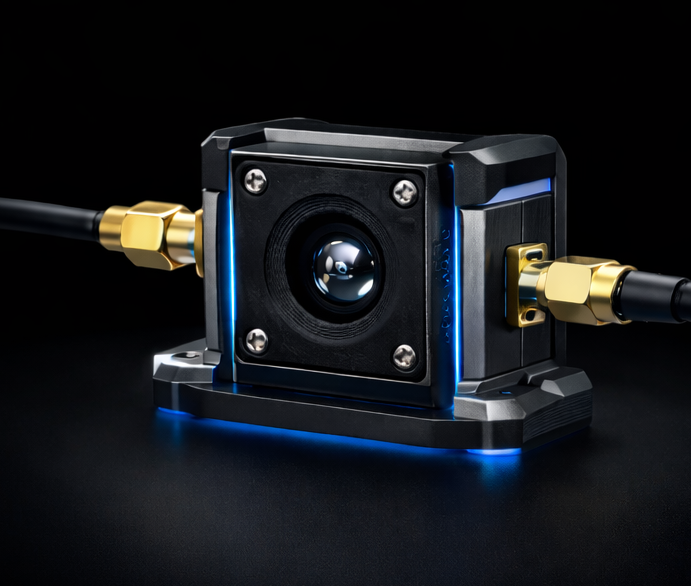
Graphene Sensing Element
Atomically thin graphene absorbers deliver exceptional THz sensitivity at room temperature, eliminating cryogenic requirements.
Antenna Coupling
Precision-engineered planar antennas maximize THz radiation capture and direct energy into the graphene channel.
Ultrafast Electrical Readout
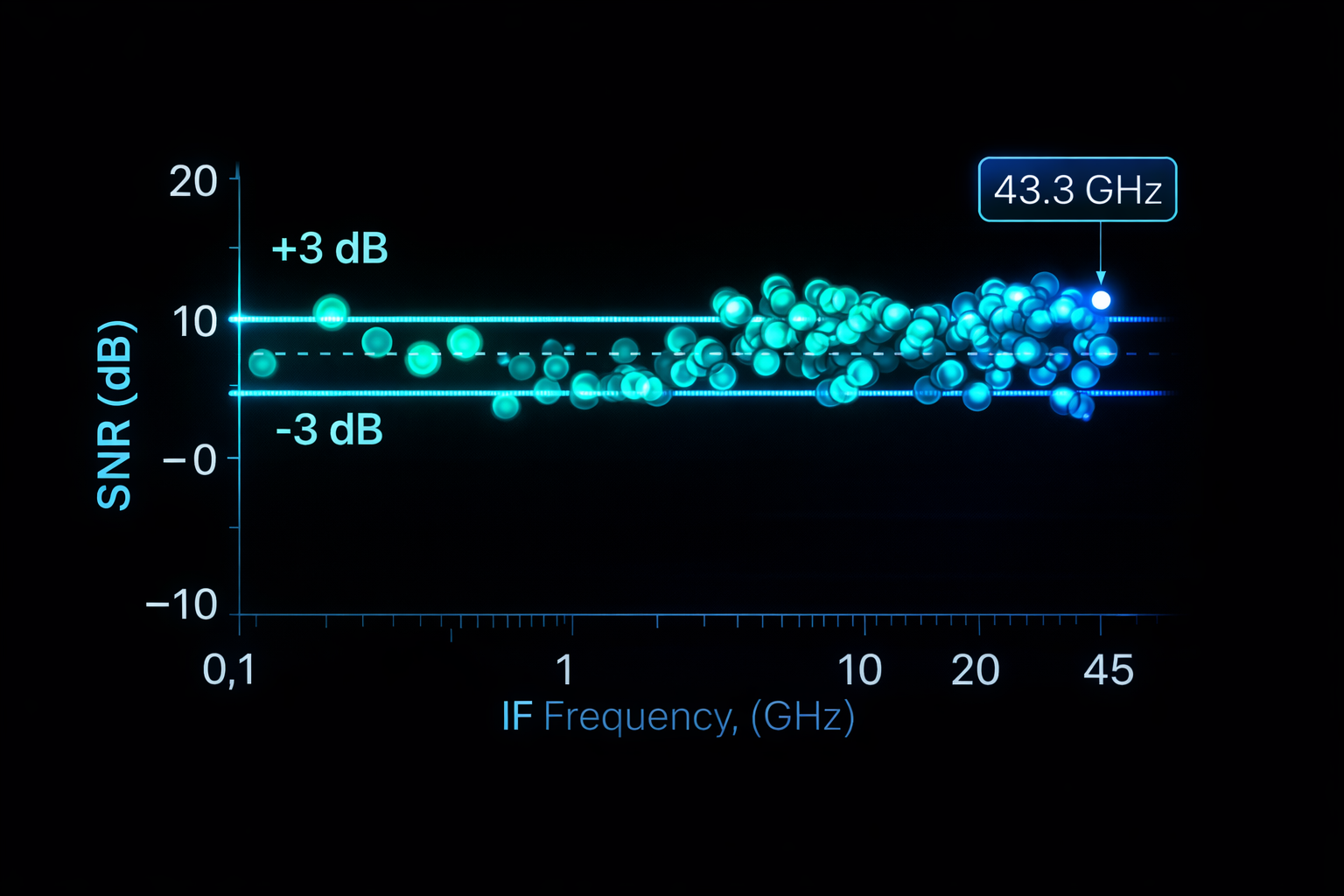
Custom readout electronics exploit graphene's intrinsic speed, enabling >40 GHz modulation bandwidth for real-time detection.
Array-Compatible Architecture
Designed from the ground up for wafer-scale fabrication, enabling large-format imaging arrays through standard lithography.
Performance
Performance Snapshot
Frequency Range
Broadband coverage across the THz gap
Responsivity
At room temperature, uncooled
Bandwidth
Ultrafast electrical readout verified
Response Time
Picosecond-scale temporal resolution
Sensor Performance
SNR vs IF Frequency — Demonstrating > 40 GHz bandwidth
Applications
Where Skyre sensors excel
Enabling next-generation 6G communications and beyond
6G Communications
Why THz
Sub-THz frequencies are critical for next-generation wireless communication links.
Why Ultrafast
10 ps response time enables ultra-fast data transfer at high bit rates.
Why Scalable Arrays
Phased-array front-ends require scalable, integrable detector elements.
Security Screening
Why THz
THz penetrates clothing and packaging for concealed-object detection without ionizing radiation.
Why Ultrafast
Ultrafast response enables real-time walk-through screening at high throughput.
Why Scalable Arrays
Large detector arrays create full-body imaging with high spatial resolution.
Industrial NDT
Why THz
Non-destructive testing of composites, coatings, and electronics packaging with sub-surface imaging.
Why Ultrafast
Fast detection enables in-line quality inspection at production-line speeds.
Why Scalable Arrays
Scalable arrays cover large inspection areas in a single pass.
IoT & Robotics
Why THz
Ultrafast communications for autonomous vehicles, drones, and robotics applications.
Why Ultrafast
Picosecond response enables real-time sensor fusion and low-latency control loops.
Why Scalable Arrays
Compact detector arrays integrate into space-constrained embedded systems.
THz Spectroscopy
Why THz
Molecular fingerprinting and material identification using characteristic THz absorption spectra.
Why Ultrafast
Ultrafast detectors enable time-resolved spectroscopy with femtosecond precision.
Why Scalable Arrays
Multi-pixel arrays allow spectral imaging for spatially-resolved material mapping.
Scientific Instruments
Why THz
Enabling new experimental capabilities in condensed matter physics and materials science.
Why Ultrafast
High-bandwidth detection captures transient phenomena and ultrafast dynamics.
Why Scalable Arrays
Array formats expand measurement capabilities for advanced research platforms.
Market Opportunity
Terahertz technology enabling the next generation of sensing and connectivity
Skyre's graphene terahertz detectors address a rapidly evolving market landscape, from current sensing applications to future wireless and immersive computing platforms.
Current Terahertz Applications
$2.3B
Global THz Technology Market by 2030
~18% CAGR (2024–2030)
Skyre initially targets high-value sensing applications where ultrafast room-temperature detectors enable capabilities not achievable with conventional semiconductor technologies.
Emerging High-Frequency Infrastructure
$10B–$30B Adjacent Markets
Wireless Test & Measurement
High-frequency wireless systems and chip validation platforms.
Semiconductor Inspection & Metrology
Advanced materials inspection and nanoscale device characterization.
Advanced Imaging & Industrial Sensing
Next-generation non-destructive testing and high-resolution sensing.
As high-frequency electronics advance, ultrafast THz detectors will become critical components in wireless testing, semiconductor metrology, and advanced sensing systems.
Future Connectivity Platforms
$100B+ Platform Markets
6G Wireless Networks
Sub-terahertz wireless links enabling ultra-high bandwidth communications.
AR Glasses
Wireless high-bandwidth links for lightweight augmented reality devices.
VR Streaming
Low-latency wireless transmission for immersive computing systems.
Holographic Communication
Future ultra-high-data-rate communication systems.
Terahertz wireless technologies are expected to play a key role in future immersive computing and next-generation wireless networks.
Current Markets
Emerging Infrastructure
Future Platforms
Competitive Landscape
How Skyre compares
| Attribute | Skyre Graphene Detectors | Schottky Diodes | Bolometers | Photoconductive |
|---|---|---|---|---|
| Speed | Excellent | Excellent | Poor | Excellent |
| Sensitivity | Excellent | Moderate | Excellent | Good |
| Broadband Response | Excellent | Moderate | Excellent | Good |
| Operating Temperature | Excellent | Excellent | Poor | Good |
| Scalability to Arrays | Excellent | Moderate | Poor | Poor |
| Integration Complexity | Excellent | Good | Poor | Moderate |
Skyre's graphene-based detectors uniquely combine ultrafast response, room-temperature operation, broadband sensitivity, and scalable wafer-level integration, enabling capabilities that are difficult to achieve simultaneously with conventional terahertz detector technologies.
Performance categories represent typical characteristics reported in terahertz detector literature and may vary depending on device architecture and operating conditions.
Product & Business Model
From graphene discovery to production
Single-Pixel Detector Modules
Evaluation kits for R&D teams and system integrators. Fully packaged detector modules with readout electronics for rapid prototyping and integration testing.
Array Detectors
Multi-pixel detector arrays for imaging and inspection systems. Scalable from small-format linear arrays to large-area focal-plane arrays.
Go-to-Market Channels
Telecom & Data Centers
Supplying detector front-ends for 6G test equipment, sub-THz communication platforms, and high-speed data center interconnects.
VR/AR Glasses
Compact THz sensing solutions for next-generation augmented and virtual reality devices.
Industrial Inspection
Integration into production-line quality control and non-destructive testing platforms.
Roadmap
Path to market
Evaluation & Integration
- Evaluation kit shipments to design partners
- Integration trials with lead customers
- Performance characterization & feedback
Array Prototype & Pilots
- Multi-pixel array prototype development
- Pilot deployments with system integrators
- Application-specific optimization
Production & Scale
- Production-ready array modules
- OEM design-in programs
- Volume manufacturing partnerships
Founding Team
World-class expertise
Graphene, terahertz technologies, and advanced sensing systems
Dr. Denis Bandurin
Founder & Chief Scientist
Experimental physicist specialising in graphene electronics, terahertz optoelectronics, and quantum transport in low-dimensional materials. Assistant Professor at the National University of Singapore and former Pappalardo Fellow at MIT.
Recipient of the Young Scientist Award from the International Society of Infrared, Millimeter, and Terahertz Waves (IRMMW-THz) for pioneering research on terahertz electron dynamics in quantum materials.
Dr. Konstantin (Kostya) Novoselov
Scientific Advisor / Co-Founder
Nobel Laureate in Physics for the discovery of graphene. One of the world's leading scientists in two-dimensional materials and their applications in electronics, photonics, and sensing technologies.
Provides strategic scientific guidance and supports the translation of advanced materials research into scalable technologies.
Dr. Lee Shiang Long
Co-Founder
Technology leader with extensive experience in defense systems, advanced sensing platforms, and large-scale engineering programs.
Supports the transition of Skyre's terahertz technology from laboratory innovation to real-world applications.
Scientific discoveries published in leading journals including Science, Nature, and Nature Nanotechnology.
Board
Dr. Denis Bandurin
Expert in graphene devices, THz electronics, and advanced transport physics. Leads Skyre's core technology development and sensor architecture.
Dr. Konstantin (Kostya) Novoselov
Nobel Laureate in Physics for groundbreaking work on graphene. Pioneering researcher in 2D materials and their applications in sensing and electronics.
Dr. Lee Shiang Long
Distinguished technologist and executive with deep experience in defense technology, advanced systems engineering, and strategic R&D leadership.
Choon Peng
Experienced business leader with a track record in deep-tech commercialization, strategy, and scaling hardware ventures from lab to market.
Eddie Chau
Seasoned entrepreneur and venture builder with expertise in bringing deep-tech innovations from research environments to commercial deployment.
Ravinder Singh s/o Harchand Singh
Technology leader with extensive experience in semiconductor systems, hardware product development, and scaling manufacturing operations.
Selected THz Publications
Dr. Denis Bandurin
High-impact journals in THz and graphene research
- Nature Nanotechnology20, 51–56 — 2025
- ACS Nano17, 8223–8232 — 2023
- Nano Letters23, 220–226 — 2022
- Nature Physics18, 462–467 — 2022
- Nature Communications12, 543 — 2021
- Nano Letters20, 5943–5950 — 2020
- Nature Communications9, 5392 — 2018
- Applied Physics Letters112, 141101 — 2018
Get in Touch
Let’s build the future of THz sensing
Whether you're exploring THz technology for your systems or seeking investment opportunities, we'd love to hear from you.